

ADA Signage Requirements Every Texas Business Should Know
For business owners and property managers, signage does more than identify a building, direct visitors, or reinforce a brand. Some signs also play an important role in making commercial spaces accessible to everyone.
That is where ADA signage comes in.
Businesses in Irving and throughout the DFW Metroplex may need signage that complies with accessibility requirements established under the Americans with Disabilities Act (ADA) and other applicable codes. From restrooms and permanent rooms to exits and accessible areas, properly designed ADA signs help customers, employees, and visitors navigate a property safely and independently.
At Sustainable Signs & Graphics, we take a collaborative, consultant-based approach to ADA signage. We help businesses understand their signage needs, evaluate their property, develop appropriate solutions, and navigate the process from design through installation.
What Is ADA Signage?
ADA signage refers to signs designed to meet accessibility standards established under the Americans with Disabilities Act.
Depending on the sign and its purpose, ADA requirements can address elements such as tactile lettering, Braille, character size, contrast, non-glare finishes, pictograms, mounting height, and placement.
These details matter.
An attractive sign that is mounted in the wrong location or uses inappropriate lettering, contrast, or tactile elements may not accomplish its accessibility purpose.
That is why ADA signage should be considered as part of an overall commercial signage program rather than treated as an afterthought.
Which Signs May Need to Meet ADA Requirements?
One of the most common questions we hear is: Does every sign in my business need to be ADA compliant?
Not necessarily.
ADA requirements vary depending on the purpose of the sign and the space it identifies. Signs identifying permanent rooms and spaces are an important category. Depending on the facility, this can include signage for restrooms, conference rooms, offices, mechanical rooms, stairways, exits, and other permanent spaces.
Directional and informational signage may also be subject to accessibility requirements, although the specifications can differ from those for permanent-room identification signs.
Temporary signs, building directories, company names, addresses, menus, and certain other sign categories can be treated differently under ADA standards.
Rather than asking a business owner or property manager to determine all of this independently, our role is to help evaluate the signage needs of the property and identify the appropriate solution.
Braille Is Only One Part of ADA Signage
When people hear “ADA sign,” Braille is often the first thing that comes to mind.
Braille is important, but compliant accessible signage involves much more.
Depending on the application, factors can include:
- Tactile characters and Grade 2 Braille for certain room-identification signs
- Appropriate character styles, proportions, spacing, and size
- Sufficient visual contrast between characters and their background
- Non-glare finishes that improve readability
- Correct use and design of accessibility pictograms and symbols
- Proper mounting location and height
The details vary by sign type, which is another reason professional planning matters.
Placement Is Just as Important as Sign Design
A correctly manufactured ADA sign can still create problems if it is installed improperly.
Accessible signage needs to be located where someone can reasonably find, approach, read, and—in the case of tactile signage—touch it.
For certain doors and rooms, specific placement rules determine where the sign should be mounted in relation to the doorway and finished floor.
Those requirements need to be considered before installation, not after signs have already been fabricated.
Our team looks at the complete signage environment so that design, fabrication, and installation work together.
ADA Signage Can Still Complement Your Brand
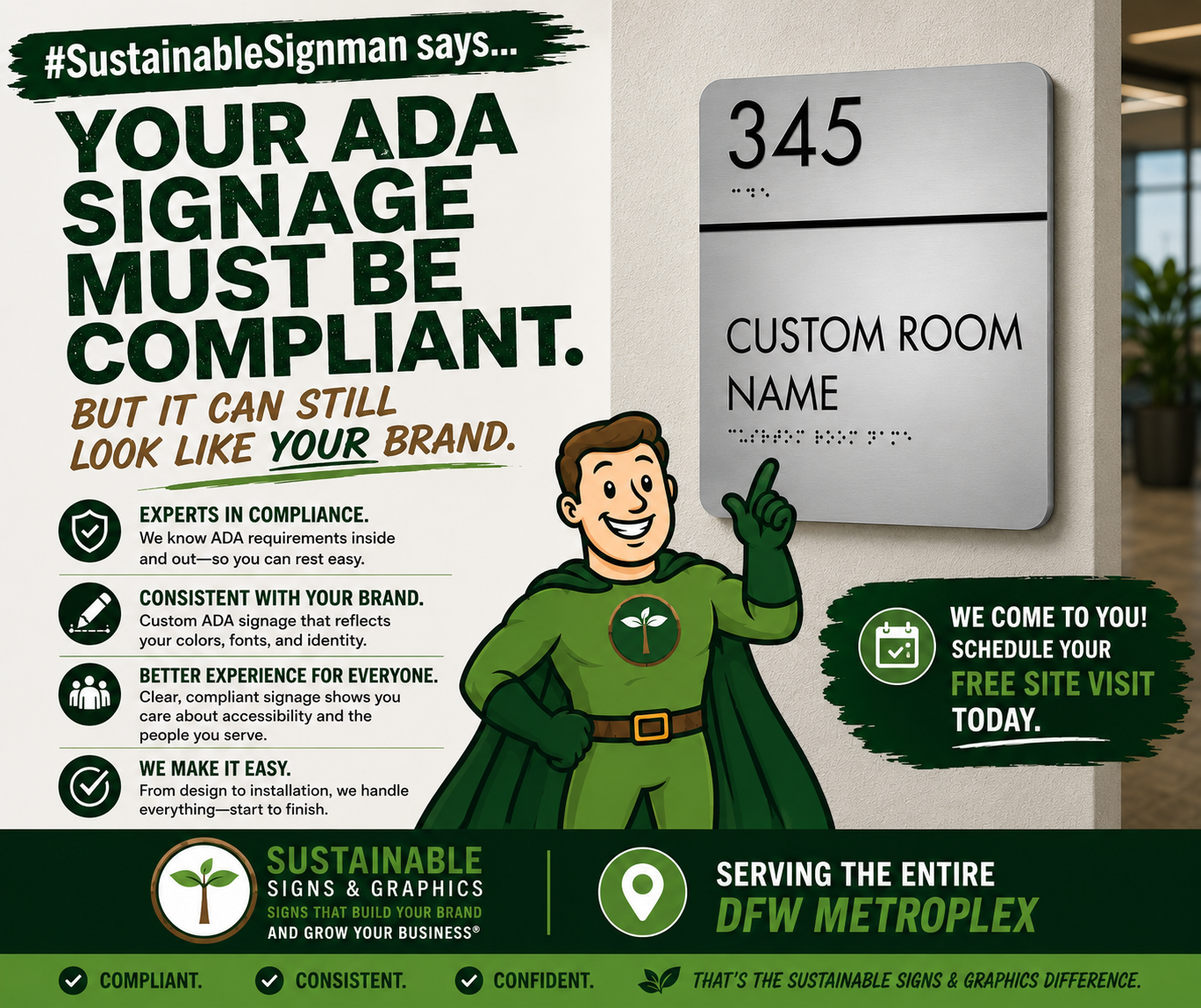
Accessibility does not mean your interior signage has to look generic.
Professional ADA signage can often incorporate colors, materials, finishes, and design elements that complement the surrounding environment while still addressing applicable accessibility standards.
For corporate offices, medical facilities, retail properties, multifamily developments, schools, hospitality businesses, industrial facilities, and other commercial properties, this provides an opportunity to create a more cohesive interior sign system.
The objective is to balance function, accessibility, durability, and design.
Why Irving Businesses Should Take a Proactive Approach
For an Irving business or commercial property, ADA signage is best addressed proactively—particularly when opening a new location, remodeling an existing space, rebranding, or replacing an outdated sign system.
Waiting until the end of a project to think about accessibility can create unnecessary complications.
By involving a professional sign company earlier, signage requirements can be considered alongside the layout, branding, construction schedule, and installation conditions.
At Sustainable Signs & Graphics, we collaborate with business owners, property managers, architects, contractors, and other project stakeholders as needed to help create a smoother process.
We Help Manage the Details
Business owners shouldn’t have to become signage-code experts just to order signs.
Our job is to serve as a signage consultant and help guide the process.
That can begin with understanding the facility and its needs, evaluating existing signage, reviewing plans or conducting a site survey when appropriate, and identifying the types of signs the property requires.
From there, we can assist with design, material selection, fabrication, placement, and professional installation.
Where local permits, codes, landlord requirements, or other project-specific considerations apply, our team helps customers navigate those requirements as part of the overall signage process.
It is a collaborative approach designed to make a potentially complicated project much easier to manage.
Don’t Forget About Sign Maintenance
ADA signage should also remain readable, secure, and in good condition throughout its useful life.
Signs can become damaged, removed during renovations, painted over, obstructed by furniture or decorations, or simply become outdated as the use of a building changes.
For larger commercial properties, periodically reviewing the signage system can help identify missing, damaged, or outdated signs.
Ask about a signage maintenance plan or recommended maintenance schedule to help keep both accessibility and wayfinding signage performing effectively.
Make Accessibility Part of a Better Customer Experience
Good signage makes a property easier to navigate. Accessible signage helps make that experience available to more people.
For Irving businesses and property managers, professionally planned ADA signage can support accessibility while contributing to a clean, organized, and professional commercial environment.
And you don’t have to navigate the process alone.
Sustainable Signs & Graphics works collaboratively with businesses throughout Irving and the DFW Metroplex to evaluate signage needs and develop solutions appropriate for their facilities.
Get a Free Signage Consultation
Are you opening a new Irving location, remodeling a commercial property, or unsure whether your existing ADA signage needs attention?
Get a free signage consultation with Sustainable Signs & Graphics. 682-800-5254
We’ll help you evaluate your property, understand your signage needs, and develop a professional solution—from planning and design through fabrication and installation.
Back
